
Overview

Podcasts are a great way to create engaging content that can be consumed easily by students. Podcasts can be listened to on-demand, whenever and wherever the listeners are. Students could be more active in their learning by making more extensive notes as they listen. They could also listen to podcasts whilst doing daily tasks, such as cleaning or cooking; such menial tasks may support their thought processes, enabling them to really think about the content of the podcast. All of this extends the learning environment from classrooms and clinical environments.
Podcasts can be distributed directly into students’ hands through their personal devices, or they can continue listening on 1Med Learn. The benefit of podcasting is flexibility: smartphone, tablet, laptop, computer or even voice-controlled devices. As students are already used to consuming content in this way, an educational podcast could slide straight into their existing routines. Engaging with podcasts may also help some learners develop their digital literacy skills and improve student satisfaction (Tam, 2012).
Educational podcasts should always be highly relevant to what is being taught, whether it be the core learning objectives, secondary components or hidden curriculum. Students value podcasts which cover material directly relevant to their studies. Podcasts could be used to support written content, lectures or online learning materials. Especially important are explanations of difficult concepts or a focus on areas where students may struggle or request additional support. They could also be dedicated episodes on feedback, expert interviews or assessments. Students value deep discussions about meaningful topics.

Podcasts are a useful supplementary tool for educators. Podcasts cannot replace the value of face-to-face teaching, but they are a worthwhile addition. Think of them as pre-vision and re-vision materials (Aliotta et al., 2008; Nortcliffe and Middleton, 2008 in Middleton, 2009). The podcast should not be a direct translation of lecture or online material but a more engaging and developed form of discussion, which extends the existing material. To support this endeavour, it is useful to have more than one host and to invite guest speakers.
Podcasts encourage deeper engagement and help to clarify information. Students can listen to episodes repeatedly for study or revision, and episodes can be consumed at each learner’s own pace.
Collaborative development of the podcast would support collective learning social processes, which underpin knowledge creation (Lee, McLoughlin and Chan, 2008 in Popova and Edirisingha, 2010). It would therefore be useful to invite students to participate in podcast recordings. They could ask questions or interview specialists.
Before you get started, listen to some podcasts to experience different approaches. Think about that you think works best and what would best suit your content and style of delivery.
Top Tips
- Create a series of podcasts and release episodes on a regular basis (weekly, fortnightly or monthly). This will help you to build an audience of listeners.
- Have a clear message. What is the podcast about? What will the episode(s) focus on?
- Use a warm and approachable tone of voice. Practice and listen back until you find a style you are happy with.
- Record in a location where there in minimal background noise (fans, traffic, people). Wardrobes are ideal as the clothes reduce echoes and reverb! There are also dedicated spaces on campus.
- Test your audio before you commit to recording your content. Record a few seconds and listen back. How does it sound? How could it be improved?
- If you are interviewing someone remotely, record each audio locally and then combine them for the best audio quality. In other words, do not record someone’s audio through speakers or over the web.
- Made a mistake? Pause and restart – but not from scratch! Mistakes can be removed in production. Pausing your commentary will give the editor the ability to cut and align the audio more easily and cleanly. (In other words, don’t rush through it!)
Technical Requirements
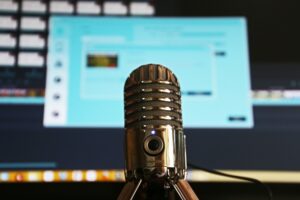
We recommend the use of Media Services Podcasting Suites. Our favourite is the six-person round table room. You can book these facilities directly by emailing mediaservices@manchester.ac.uk, and a technician will be on hand to support you.
- Recording hardware options
- Voice recorder with an in-built microphone
- USB recorder used with computers and laptops
- Lav mic used with mobile phones
- Best file format: WAV
- Recommended recording and editing software:
- Transcript: Every podcast needs a transcript for each episode to make the content accessible to more people. This can be automatically generated but needs to be checked before distributing to students.
- Distribution: SoundCloud is very versatile as it will allow you to distribute your podcast by sharing a link, embedding it into another website, directly downloading it to a devices or allowing listeners to subscribe to an RSS feed (linked to a profile).
MBChB eLearning can support you by hosting and distributing your episode via the 1Med Learn Podcast, to which students can subscribe. Students will be able to access content on any device via a RSS feed. eLearning will provide a user guide for students. Email MBChBeLearning@manchester.ac.uk for further information.
Recommended Podcasts for Medical Education
Do you have another recommendation? Email us: MBChBeLearning@manchester.ac.uk
References
- Lonn, S. & Teasley, S.D. (2009). Podcasting in higher education: What are the implications for teaching and learning? The Internet and Higher Education. Volume 12, Issue 2. Pages 88-92.
- Lonn, S. & Teasley, S.D. (2009). Podcasting in higher education: What are the implications for teaching and learning? The Internet and Higher Education. Volume 12, Issue 2. Pages 88-92.
- Popova, A. and Edirisingha, P. (2010). How can podcasts support engaging students in learning activities? Procedia – Social and Behavioral Sciences, 2(2), pp.5034–5038.
- Tam, C.O. (2012). The effectiveness of educational podcasts for teaching music and visual arts in higher education. Research in Learning Technology 2012, 20: 14919.
- The Podcast Host (2022). Podcasting in Education: What Are the Benefits?
- University College London (2022). Getting started with podcasting at UCL.