

By Sally Hickson, PFHEA, Senior Lecturer in Health Sciences Education Development, Academic Lead for Accreditation
When we think about feedback, many of us might think it is just the feedback, or rubric allocations we provide on an essay or other assessment. It’s a transactional process: the student does the piece of work, we provide the feedback. What this doesn’t enable is a continuous learning process whereby feedback is frequently provided at appropriate stages whereby learners can engage with the feedback, ask questions or clarification on that feedback, use that feedback directly in the work they are producing and how that feedback can inform their future work. Nor does it consider how students feel about receiving that feedback which may determine their acceptance and use of it.

Is this a buzz word/term? Maybe, but it’s certainly been something that educators have been grappling with for years. At its core, it’s about a learner’s ability to appreciate the value and role of feedback, make judgements about their own work and others, how they react to receiving feedback and what they do with that feedback (Carless and Boud, 2018).
There is a mountain of resources in the literature about this topic – feel free to get in touch with me if you’d like to explore this topic in more depth. To give you some useful resources and options, I’ve included a few below which are referenced at the end so that you can find out more.
1. Feedback Literacy Behaviour Scale
This framework was devised by Phillip Dawson et al (2023) at Deakin University, whereby learners can measure their own feedback behaviours and enactment of their level of feedback literacy. The scale is also available under a Creative Commons Attribution (CC-BY) license at feedbackliteracy.org. It involves asking students to rate how often they do various thing relating to feedback by rating their responses to questions covering five factors: Seek Feedback information (SF), Make Sense of information (MS), Use Feedback information (UF), Provide Feedback information (PF), and Manage Affect (MA).
How you can use this:
- Ask your learners to complete the questionnaire and get them to discuss their results with you and/or their peers.
- Break the scale down into sections and have a quick in-class discussion
- Review the prompts in the scale to see where you could build in opportunities that might address some of the points being explored
2. Feedback for Learning
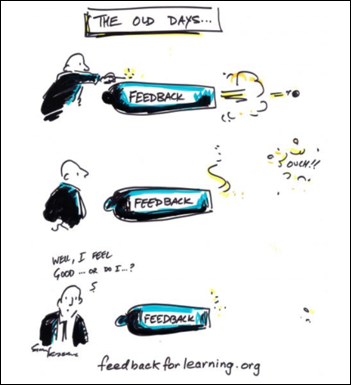
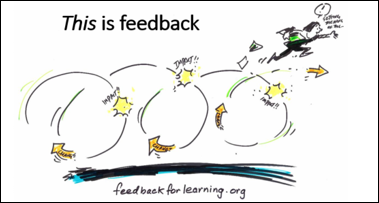
Another excellent resource from the Australian Universities of Deakin, Monash and Melbourne . They crucially define feedback as a “process in which learners make sense of information about their performance and use it to enhance the quality of their work or learning strategies”. Within their resource – which is mainly about creating and ways of using feedback effectively and closing the assessment loop – are some pointers to thinking about and enacting feedback differently. Their diagrams are impactful in getting us to see feedback as going
From this (transactional, one-off feedback):
To this (cyclical process):
How you can use this:
- Explain to your learners the value of feedback, why it is helpful to their skill development, their learning and the completion of an assessment task
- Ask your learners where, when and how they would like to receive feedback that would be most helpful to them
- Explore ways in which your learners use their feedback. You could ask in class after a formative exercise, or at their next assessment point.
3. Exploring Feedback Literacy Through Student Self-Reflection
This article by Kurt Coppens, Lynn Van den Broeck, Naoimi Winstone and Greet Langie (2024) includes a mixed methods approach to explore feedback literacy. Interestingly they focus on learners’ transition from secondary education to university and their development of feedback literacy, particularly in the first year. They also hypothesise that learner’s feedback literacy and their self-reflection measures are positively related; the more literate learners are about feedback leads to better self-reflection which cycles back to increased feedback literacy.
How you can use this:
- Ask your learners to write reflective logs describing a personal feedback experience that they believed had an impact on their learning process
- Unpick your marking criteria with your learners so they understand how different grades are allocated
- Get your learners involved in providing peer feedback so they experience both giving and receive feedback, and reflect on that process
4. Student Self-Feedback
Jenni Rose in the Faculty of Humanities has led a project and published work on ‘active self feedback’ whereby students write feedback for themselves in response to structured prompts. Jenni’s work highlights measurable gains in students’ performance, intellectual development and also reports increases in students’ confidence, motivation and engagement. In a nutshell, students are asked to write a piece of work and then compare that to two exemplars. Using a series of questions and prompts, they then write feedback to themselves that includes actionable tasks for them to address. She also created space for peer and whole class discussion and then students were given time to rewrite their work, using that feedback – all within a 40 minute teaching session. Jenni’s work with a guide to staff is available on the University’s website: ITL Fellowship Projects – Assessment and Feedback
How you can use this:
- Consider using Jenni’s model in a session of your own.
- Choose a task that would support students’ learning or preparation for their assessment. Select two ‘good’ exemplars for them to compare their work with.
- Create some prompts or questions for your students to respond to in writing their own feedback.
- Access the resources linked through Jenni’s project, including a Padlet, where there are numerous examples of similar application.
5. Staff Feedback Literacy
Let’s not forget about teacher feedback literacy! How we design, deliver and engage with feedback affects how our learners engage with and benefit from feedback. Phillip Dawson and David Boud (both prolific writers in this field) collaborated with Turkan Istencioglu and Lan Yang to produce a Teacher Feedback Literacy Scale[i] that intends “to measure teachers’ design-oriented, enacted feedback practices in higher education” – basically how do you design, provide and engage in feedback. The scale includes 30 prompts across 5 themes:
- Design for student action on feedback (DSAF);
- Design and implement peer feedback (DIPF);
- Develop students’ feedback literacy (DSFL);
- Design and sequence feedback processes (DSFP);
- Manage feedback priorities (MFPR)
How you can use this:
- Download the tool – it’s in an appendix in the article – and have a look through the prompts.
- Think about what you usually do in your programme or course units.
- Rate how often you engage in each behaviour in your current teaching practice
- Find one thing from the scale that you can implement or change, and then find another…
- It would make a great reflective piece for some CPD or personal development
Feedback literacy is important for our learners and our staff. The more literate we all are, the better our production and use of feedback will be.
References
Carless, D., & Boud, D. (2018). The development of student feedback literacy: Enabling uptake of feedback. Assessment & Evaluation in Higher Education, 43(8), 1315–1325.
https://doi.org/10.1080/02602938.2018.1463354
Coppens, K., Van den Broeck, L., Winstone, N., & Langie, G. (2025). A mixed method approach to exploring feedback literacy through student self-reflection. Assessment & Evaluation in Higher Education, 50(2), 173–186. https://doi.org/10.1080/02602938.2024.2373792
Dawson, P., Yan, Z., Lipnevich, A., Tai, J., Boud, D. & Mahoney, P. (2023). Measuring what learners do in feedback: the feedback literacy behaviour scale. Assessment & Evaluation in Higher Education. https://doi.org/10.1080/02602938.2023.2240983
Istencioglu, T., Yang, L., Dawson, P., & Boud, D. (2026). How do teachers design and do feedback? Development and validation of the teacher feedback literacy scale. Assessment & Evaluation in Higher Education, 1–21. https://doi.org/10.1080/02602938.2026.2661361
Nicol, D., & Rose, J. (2025). Promoting learner self-regulation: is it better to give students exemplars before or after producing work? Assessment & Evaluation in Higher Education, 1–21. https://doi.org/10.1080/02602938.2025.2534870
Leave a Reply